
Termite (Isoptera) – Identification, Behaviour, Damage, and Control in India 2025 Guide
Overview
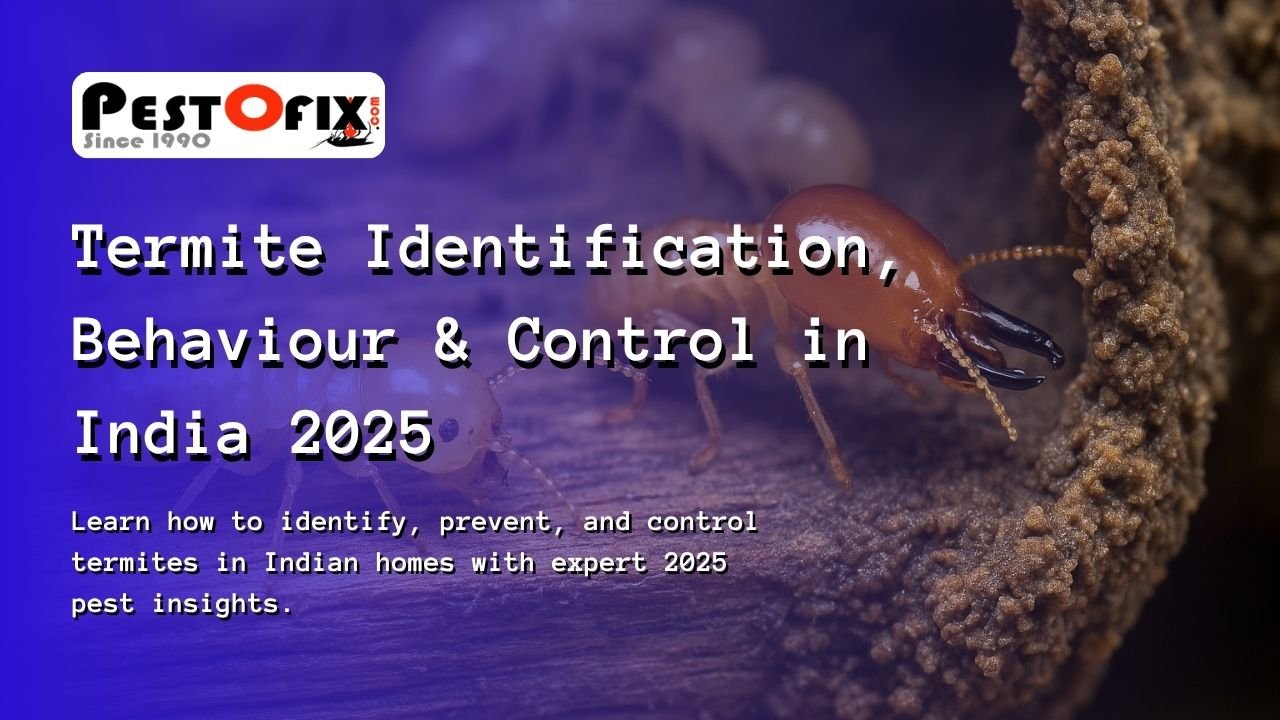
Termites are eusocial insects that primarily consume cellulose — the main structural component of wood, paper, and plant fibres. While they are important decomposers in natural ecosystems, several termite species are major structural pests in human habitations. In India’s varied climates, termites occur across urban and rural landscapes and are responsible for significant damage to buildings, furniture and agricultural materials.
Classification
Kingdom: Animalia
Phylum: Arthropoda
Class: Insecta
Order: Blattodea (infraorder Isoptera)
Families commonly encountered in India include Termitidae, Rhinotermitidae, Kalotermitidae and Hodotermitidae. Modern taxonomy places termites within Blattodea (the cockroach group) but they retain the traditional name “Isoptera” in many applied references.
Physical Characteristics
- Body: Soft-bodied, pale to brown in colour; workers and soldiers are usually blind or functionally blind.
- Size: Typical workers measure 3–6 mm; reproductive individuals (alates) are larger and winged.
- Antennae: Moniliform (bead-like), distinguishing them from ants (elbowed antennae).
- Waist: Broad and not constricted (unlike ants which have a narrow petiole).
- Wings: When present, alates have two pairs of roughly equal wings; discarded wings near light sources are a common sign of swarms.
Social Structure and Castes
Termites are highly social and live in colonies with a division of labour among castes:
- Queen: Primary reproductive female; may live for many years and produce thousands of eggs.
- King: Mate of the queen; remains with the colony.
- Workers: Sterile individuals responsible for foraging, nest maintenance, and feeding other castes.
- Soldiers: Defend the nest; often have enlarged mandibles or chemical-defence structures.
- Alates (swarmers): Winged reproductives that disperse seasonally to found new colonies.
Lifecycle
Termites undergo incomplete metamorphosis: egg → nymph → adult (worker, soldier or reproductive). Nymphs may differentiate into different castes depending on colony needs. Swarming (the dispersal of alates) is a key reproductive event and commonly precedes the establishment of new colonies.
Seasonality: In many Indian regions swarming peaks around the onset of the monsoon (May–July) but timings vary by species and local climate.
Major Termite Species Encountered in India
| Scientific Name | Common Name | Family | Typical Habitat | Pest Status |
|---|---|---|---|---|
| Coptotermes heimi | Subterranean termite | Rhinotermitidae | Soil, foundations, structural timber | Severe - major structural pest |
| Odontotermes obesus | Indian white termite | Termitidae | Mounds, decaying wood, soil | High - common in fields and wood |
| Heterotermes indicola | Subterranean termite | Rhinotermitidae | Buildings, trees, soil | Severe |
| Cryptotermes domesticus | Drywood termite | Kalotermitidae | Wooden furniture, frames | Moderate - furniture infestations |
| Microcerotermes beesoni | Tree-nesting termite | Termitidae | Dead wood, tree trunks | Low to moderate |
Habitat and Distribution
Termites are distributed across India — from arid interiors to humid coastal plains. Their local abundance depends on soil type, moisture, availability of cellulose materials and human construction practices. Urbanisation, landscaping, and poor construction practices (wood-to-soil contact, unresolved dampness) increase the risk of termite problems.
Behaviour and Ecology
Key behavioural traits:
- Foraging: Subterranean species forage via covered mud tubes that protect them from desiccation and predators.
- Communication: Use pheromones and substrate vibrations for coordination.
- Feeding: Digest cellulose with the aid of symbiotic gut protozoa and bacteria.
- Nest types: Subterranean (underground with foraging galleries), mound-builders (epigeal mounds), and wood-nesting (within lumber or structures).
Signs of Infestation
Early detection improves remediation outcomes. Look for:
- Mud tubes along foundations, skirting boards or inside cavities.
- Hollow-sounding timber or “maze-like” tunnels under paint or varnish.
- Discarded wings near windows, doorways or light sources (after swarms).
- Fine powder or pellet-like frass (especially from drywood termites).
- Blistering paint, sagging floorboards or squeaky doors that indicate internal wood hollowing.
Damage and Economic Impact
Termite damage ranges from localized furniture damage to structural compromise of load-bearing members. Repair costs often exceed treatment costs, particularly when infestation is longstanding. In urban India, damage can affect flooring, doorframes, rafters, books, insulation and electrical insulation (indirect risk of short circuits where wiring is chewed).
Prevention: Best Practices for Homes and Buildings
- Design & Construction: Maintain a gap between soil and timber elements; use concrete plinths and termite shields where possible.
- Moisture Management: Repair leaks, ensure adequate drainage, ventilate crawlspaces and attics.
- Material Selection: Use termite-resistant or treated timber for construction and furniture.
- Landscaping: Avoid piling wood or mulch against the building; keep plants trimmed away from walls.
- Regular Inspection: Annual professional inspections and periodic homeowner checks reduce risk.
Control and Treatment Methods
Chemical Control
Chemical methods remain the most common professional treatment. Techniques include:
- Pre-construction soil treatment: Application of a chemical barrier (termicide) around and under the foundation prior to flooring. Common active ingredients: fipronil, imidacloprid, chlorpyrifos (usage governed by local regulations).
- Post-construction trenching and pressure injection: Creating a continuous barrier by injecting termiticide into drilled soil holes around the structure or along walls.
- Wood treatment: Surface sprays or pressure impregnation with borate solutions for furniture and structural timber.
Baiting Systems
Baiting involves placing cellulose baits containing slow-acting insect growth regulators (IGRs) or chitin synthesis inhibitors in monitoring stations. Workers feed on bait and transfer it through trophallaxis, eventually affecting the colony. Baiting is particularly useful where constructing soil barriers is difficult or for targeted, low-toxicity control.
Physical and Mechanical Methods
- Removal of infested wood and replacement with treated materials.
- Installation of physical barriers (stainless steel mesh, sand barriers of specific particle size).
- Heat or fumigation for contained wooden items or small structures (note: fumigation requires specialised applicators and may not be suitable for all contexts).
Biological Options
Research and limited field application of biological control agents — entomopathogenic fungi (Metarhizium, Beauveria) and nematodes — show promise, especially for targeted or environmentally sensitive sites. Field efficacy and formulation stability are ongoing areas of study.
Integrated Termite Management (ITM)
ITM combines inspection, monitoring (bait stations), physical exclusion, habitat modification (moisture control), and selective chemical or biological tools. ITM emphasises long-term prevention, minimal chemical usage, and documented follow-up.
Safety, Environmental and Regulatory Considerations
- Follow manufacturer and regulatory guidelines for all termiticides; misuse can harm non-target organisms and humans.
- Many modern formulations are low-odour and low-volatility, designed to reduce human and pet exposure.
- Ensure licensed applicators and ask for detailed treatment reports and safety data sheets.
- Proper disposal of leftover chemicals and contaminated materials is critical; follow local CPCB/BIS recommendations.
Regional Notes (India-specific)
Species composition and risk zones vary regionally:
- Coastal & humid regions: Higher incidence of dampwood and subterranean species due to moisture availability.
- Arid interiors: Lower overall density but drywood infestations may persist in untreated wooden furniture.
- Urban apartments: Rising drywood issues due to imported or reclaimed furniture and reduced ventilation in sealed units.
Common Myths and Clarifications
- Myth: Termites only attack old buildings. Fact: Any untreated or moisture-exposed wood is susceptible regardless of building age.
- Myth: Surface sprays alone will eliminate a colony. Fact: Surface treatments may kill exposed individuals but rarely affect the colony; soil barriers or baiting are needed for colony-level control.
- Myth: White ants are ants. Fact: “White ant” is a colloquial term for termites; they are a distinct insect group (Isoptera/Blattodea).
Inspection Checklist (Homeowner)
- Check for mud tubes on foundation walls and under floor skirting.
- Tap wooden beams and furniture; listen for hollow sounds.
- Inspect areas with past leaks or high humidity (bathrooms, kitchens, basements).
- Look for discarded wings near windowsills after seasonal swarms.
- Examine wooden doors and frames for soft spots or blistering.
- Ensure no wood is in direct contact with soil; store firewood away from the house.
FAQ
How soon should I call a professional if I find signs?
Contact a licensed pest-control professional as soon as possible after detection; early intervention drastically reduces repair costs and increases treatment success.
Are DIY chemical sprays effective?
Surface DIY sprays can suppress visible termites but rarely eliminate a colony. For reliable, long-term control, professional assessment and colony-targeted treatments (barriers, baiting) are recommended.
Can treated timber prevent infestation?
Pressure-treated or borate-treated timber significantly reduces susceptibility, but no material is invulnerable if conditions (moisture, continuous food source) are favourable to termites.
Recent Research & Emerging Technologies
Areas of active research include:
- Improved bait toxicants and delivery systems for greater colony suppression.
- Biological control agents with field-ready formulations.
- Sensor and acoustic monitoring devices for early detection of internal wood activity.
- Studies of termite gut microbiomes for novel control targets and bioconversion applications.
Summary
Termites represent a persistent threat where cellulose materials and favourable environmental conditions coexist. Prevention — through moisture control, good construction practice, material selection and regular inspection — is more cost-effective than post-damage repair. Where infestation occurs, an integrated approach combining monitoring, physical exclusion and targeted chemical or bait-based treatments provides the best long-term outcome.
No comments yet — be the first!